
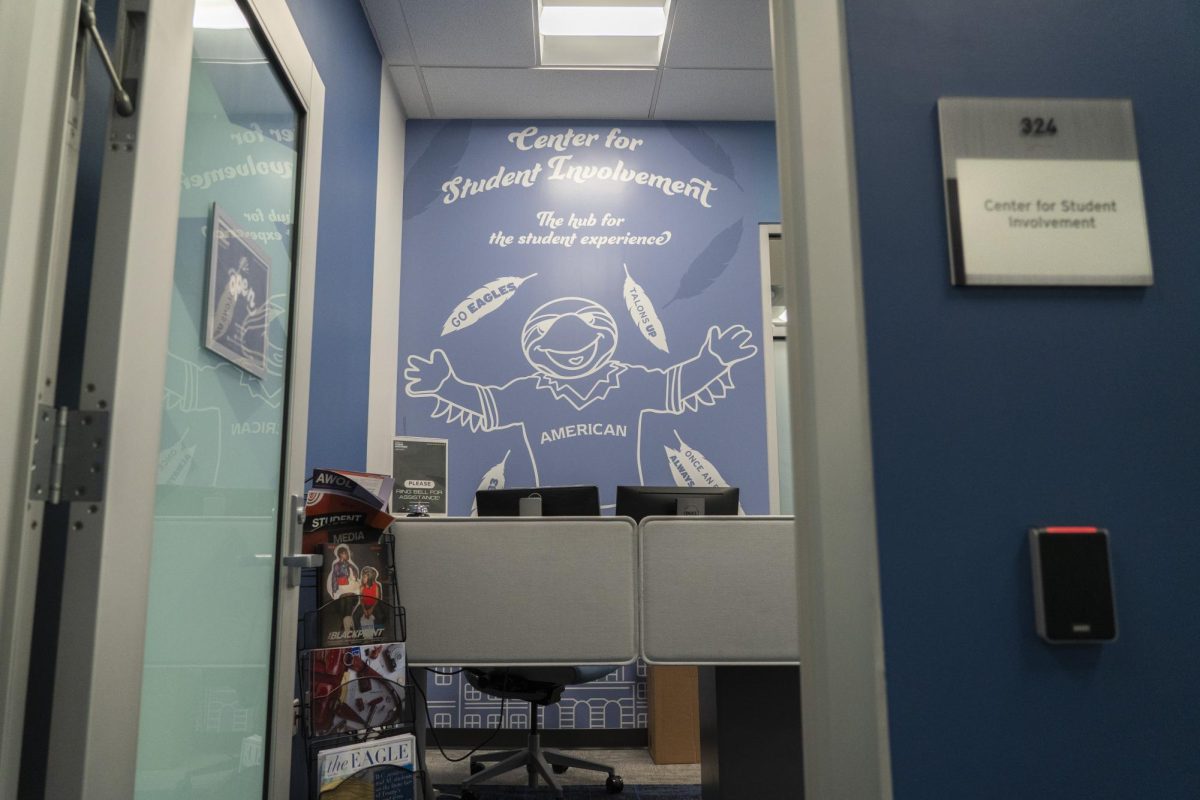
Editors’ note: Over the summer, the Center for Student Involvement rejected AWOL’s application for re-registration. No one who was in correspondence with CSI over AWOL’s re-application was involved in the pitching or reporting of this article.
Michael McGee-McCoy became chair of Brother Brother’s board because he saw it as a unique space for Black men to mentor each other on American University’s campus. After the Center for Student Involvement rejected their re-application for recognition for the third time, he began to doubt if the club would be able to run.
McGee-McCoy said CSI rejected his application once for having old emails on the club roster, again for not including a new non-discrimination statement in the constitution and finally for not including that statement verbatim.
“You were worried that you didn’t have something done or complete, the club wasn’t going to be recognized on campus,” McGee-McCoy said.
In August, CSI added 55 pages to the Recognized Student Organization Manual, more than doubling its length from the 2024-2025 academic year, according to AWOL’s inspection of those documents. The new pages included information on new required trainings for club leaders, clarified policies for Fraternity and Sorority Life, new requirements for Engage rosters and a non-discrimination clause required for all clubs’ constitutions. Clubs that submitted a re-registration form that did not adhere to new policies were rejected and had to reapply.
Brother Brother was one of six AU student organizations whose leaders AWOL spoke with that had to wait weeks to be registered this semester while they faced rejections and delays from CSI. Student leaders attributed the backup to confusion surrounding new recognized student organization policies.
Student leaders said the new policies and continuous clerical backups have caused issues ranging from exclusion from promotional events to a shift in their club’s identity after CSI’s addition of the non-discrimination clause. Others said increased bureaucracy has only been a minor inconvenience. Meanwhile, club leaders at other Washington universities told AWOL their schools’ reapplication processes are comparatively straight forward.
In a statement emailed to AWOL, Assistant Vice President and Deputy Chief Communications Officer Elizabeth Deal said more groups were able to renew at the beginning of this semester than in previous years, but CSI will still be updating the renewal process next year.
“Given student feedback on the annual renewal process, CSI will be overhauling the annual renewal next year, intending to streamline requirements and expedite the process to reduce tasks for student leaders over the summer and make the process more efficient,” Deal said.
Guidance from above: a new non-discrimination clause
The non-discrimination clause, a new CSI policy, appeared on page 56 of the student organization manual in August. The clause reads:
“American University student organizations shall not discriminate in membership or benefits on the basis of any individual’s personal identity or characteristics, including but not limited to race, color, national origin (or shared ancestry), religion, sex, age, sexual orientation, disability, or veteran status.”
All clubs are now required to add the clause into all club constitutions, flyers and Engage advertisements for organization-sponsored activities, according to the RSO manual. Deal said in her statement that this was a long-standing requirement that student organizations are now required to clarify during the annual renewal process.
CSI included the clause after President Donald Trump began efforts to overhaul diversity, equity and inclusion initiatives in higher education. An April 23 executive order prohibited DEI-related criteria from university accreditation processes and threatened to deny or terminate the accreditation of universities that practice DEI. Funding can be revoked from universities for having programs exclusive to specific races, sexes or other protected groups, according to guidance published on July 29 by United States Attorney General Pam Bondi.
“It’s definitely them playing smart to sort of navigate through the Trump administration to protect our university,” said Tina Dao, president of the Southeast Asia Student Network.
Deal referred AWOL to a June 9 email that CSI sent to student organizations. In the message, CSI said the changes to organization requirements came in response to federal actions.
“Consistent with AU’s institutional obligations following recent federal government actions—the Center for Student Involvement is required to incorporate updated requirements related to openness and accessibility into the annual renewal process for all recognized student organizations,” CSI wrote. “These changes are essential to ensuring that all RSOs remain open, inclusive, and accessible to the entire student body.”
Mercy Asamoah, president of Brave Spaces, a group promoting marginalized voices, said CSI denied the club’s application because Brave Spaces’ mission statement said the group advocates for Black, Indigenous and other people of color, but was not clear that white people were welcome. She said white people are welcome at Brave Spaces, but she worried the new language would de-center marginalized groups and distort the group’s message.
“We do want that accompliceship,” Asamoah said. “But we also want to make sure we don’t forget the original point of orgs like Brave Spaces. For example, making sure we have BIPOC and marginalized students at the forefront.”
Even though the non-discrimination clause was required for all student organizations, Asamoah said it disparately impacts affinity and identity-based groups.
“I kind of just felt as though that the school was just mainly complying with what, like, the federal policies instead of mainly kind of advocating for their students,” Asamoah said.
McGee-McCoy said Brother Brother’s executive board held several meetings to determine how to integrate this statement into their constitution, given that the group is intended to provide mentorship for men of color. He said Brother Brother is now less open about how it advertises its events, no longer using racial or other identity-related terms in flyers or social media posts.
While he said he was not inherently opposed to the new language, McGee-McCoy said the deadlines and lack of communication from CSI made it difficult to adapt, especially given the executive board’s busy schedules.
“We would have liked to do it on our terms,” McGee-McCoy said. “There were a bunch of different things that we had to get done in this small amount of time. We’re still trying to move into the university, we still got family, all these different things and we’re trying to accommodate our life.”
Not all clubs faced issues with the new clause. Stella Del Carmen, president of the Association of Latino Career Enhancement, said she was able to incorporate the clause into the club’s constitution without much extra work. When questions arose, she said CSI was consistently available for questions.
“It wasn’t super difficult to do because they gave us the clause to add,” Del Carmen said. “It was super clear.”
Director of the AU Spirit and Traditions Board and former Student Activity Council co-chair Emily Moro said the new clause is more likely based on student concerns about accessibility and feeling welcome than federal actions. She said students often felt hesitant to attend events marketed towards identity groups they were not a part of and the new clause was intended to help them feel included.
“It’s more for the students who were feeling concerned they weren’t welcome in places,” Moro said. “It served as a kind of reminder to students that everywhere on campus they’re welcome.”
While several club leaders said adding this clause added to the bureaucratic struggles they were facing, several organizations didn’t find the language itself problematic. Leaders of affinity and cultural organizations also did not find it damaging to their clubs’ goals.
Former Chabad President and current Hillel intern Brayden Serphos said he thought the new language would benefit the group by encouraging non-Jewish students to attend their events.
“I think that this will make it more marketable as a place that people are welcome,” Serphos said.
McGee-McCoy said that adding the non-discrimination statement to his advertisements has diversified club membership.
“Brother Brother now has, you know, non-Black students within it, which is amazing to see,” McGee-McCoy said.
While McGee-McCoy said the new clause forced Brother Brother to change some of its practices, it would not impact the group’s mission or activities.
“We are in ways hindered from being fully acclimated in the way that would best suit us or that we would feel would best suit us, and that is only literally a structure-based thing,” said McGee McCoy. “We’ve still been able to continue our great conversations and service those different aspects.”
New semester, codified bureaucracy
Another new section of the RSO manual added 15 pages of Fraternity and Sorority Life policies containing guidance on recognition requirements, membership policies and Greek life authority structures.
Deal said in her statement to AWOL that these were pre-existing policies that previously existed in a separate document. She said they were incorporated into the RSO manual to improve transparency.
Ethan Kassar, president of Alpha Epsilon Pi fraternity, said the new pages did not impact Alpha Epsilon Pi’s practices.
“A lot of it was things that were already done in practice, but not written out,” Kassar said.
Kassar said he did take issue with the new anti-hazing online course. While CSI required only the leaders of some student organizations to participate, Kassar said all Greek organization members had to complete it. He said he thinks the extra steps stem from stigma around fraternities. According to a study by the University of Cincinnati, 73% of students in fraternities or sororities across 53 colleges and universities experienced hazing. Greek life had the second-highest rate of hazing, after varsity sports.
“I know of student organizations who practice hazing policies, and it doesn’t make sense that the recognized student orgs and Greek life organizations are treated differently,” Kassar said.
The new manual also required organization leaders to attend RSO retreats. Moro, the director of the Spirit and Traditions Board, said these retreats could take upward of four hours.
“They kind of sit there for a couple hours and like spew all this policy stuff at you that I personally feel could be sent out in an e-mail,” Moro said.
Not a universal problem
Georgetown University’s chair of the Council of Advisory Boards, which oversees the New Club Development process, Christian Spadini, said clubs have always been required to state that they are open to all in their constitutions, but said Georgetown’s administration has not made any changes to how clubs can advertise themselves.
Spadini said clubs are usually only rejected for reapplication if they have failed to fulfill their meeting requirements during the year, do not fill out budget and roster forms or if they violate the law or university policy. Spadini also said Georgetown has many unofficial organizations without access to benefits that are allowed to participate in their club fair in a “free speech zone.”
Shiva Ranganathan, president of Georgetown Asian American theatre group (No) Pressure Creatives, said the organization focuses on Asian American stories but has non-Asian members who contribute to productions.
Ranganathan said (No) Pressure Creatives is currently in the process of applying for university recognition. While planning an application can take several years, re-registration usually entails attending budget meetings and updating rosters, Ranganathan said.
President of the Howard University chapter of Big Sister-Little Sister, Myla Roundy, said that while her university’s club registration process was tedious at times, she never had an issue registering or communicating with student affairs. She had never heard of a club being rejected for re-registration.
“The process really is kind of seamless,” Roundy said.
Rejections, delays and clerical errors
In the past, registration for previously recognized organizations at AU involved simple updates to the constitution, like removing contacts for graduated members or updating event dates, five AU student leaders said. Bureaucratic obstacles related to integrating the new policies caused delays to recognition that prevented student organizations from participating in campus events.
Leigh Carr, the president of Hawai’i Club, stayed up until 3 a.m. waiting for her club to be recognized.
CSI had rejected her application at 8 p.m. on Aug. 27, and she was unsure if she would be able to advertise her club at a “Welcome Week” event the next day.
Carr would not hear back from CSI until a week later, the night before the Student Involvement Fair.
“The complete radio silence was driving me nuts,” she said.
Carr said her application was rejected two days before the deadline for submission because of a policy described in the extended “Technology for Student Organizations” section of the RSO manual, which requires that organizations’ rosters use “@american.edu” email addresses instead of “@student.american.edu,” though emails with either domain would reach the same person.
“I ended up taking maybe two hours going through our whole roster,” Carr said.
Carr edited the roster before Culture Fest, a campus event to introduce new students to affinity and cultural student groups. She said the event helps Hawai’i Club advertise itself to underclassmen and garner new membership, but no one had told her if the club could participate, since they were still unrecognized.
In the end, she said CSI employees gave her a space at the event.
Clerical errors have limited some new student organizations’ campus involvement since at least 2023. Email screenshots that the former general events coordinator of the organization Jewish Voice for Peace shared with AWOL show that CSI rejected JVP’s application several times over the course of the Fall 2024 semester before CSI froze club registration on Dec. 13, 2024. CSI employees told club leadership JVP was denied over an issue with a club member’s email domain. As a result, JVP was unable to register as a recognized student organization for the entire 2024-2025 academic year.
A screenshot included in the documentation that JVP shared shows CSI initially denied the acapella group DCrescendo’s application in October 2023 for listing one of their members’ email domains as “@american.edu” instead of “@student.american.edu.”
CSI employees Maura Fox, Maya Vela and Matthew Galewski, who the screenshots show were in correspondence with those two organizations over their applications, did not respond to requests for comment. Deal said all new clubs applying for recognition at the time when CSI froze registration had their applications paused, but none were rejected. Deal said all of those clubs were given the opportunity to apply after CSI completed a review of the recognition process.
McGee-McCoy said Brother Brother’s application was rejected several times over the 2025 summer break. Along with having to correct emails on the roster, McGee-McCoy said a technology issue prevented him from uploading a new version of his constitution to Engage, meaning Brother Brother was not recognized until weeks into the semester and could not participate in the Student Involvement Fair.
“We definitely know that would have helped, to get our faces out there earlier than later, and so we can’t have that moment back,” McGee-McCoy said.
Deal wrote in her statement to AWOL that the Engage glitch was part of a necessary technology update.
McGee-McCoy and Carr both said they wished CSI officials would have contacted them about the issues and replied to their questions sooner.
“I understand that you guys are busy and you have lives and that you have work,” Carr said, referring to CSI employees. “But if you’re the point of contact for a club and we’re stressed, please respond.”
Despite the problems he faced with registering Brother Brother, McGee-McCoy said he felt that CSI was doing the best they could.
“Leaders need grace,” he said, “I do appreciate the work that they’ve done and that they did to help us.”
Sana Butt contributed reporting to this story.
Edited by Kyle Galvin, Will Sytsma and Kalie Walker