

Off of the main campus and north on Massachusetts Avenue, American University has a vault.
Nestled in the shelves of the university’s Department of Archives and Special Collections are early-drawn plans for the university, issues of student publications, handwritten notes from past university presidents and hardly-recognizable photos of campus during its construction.
But the archives contain more than AU’s history.
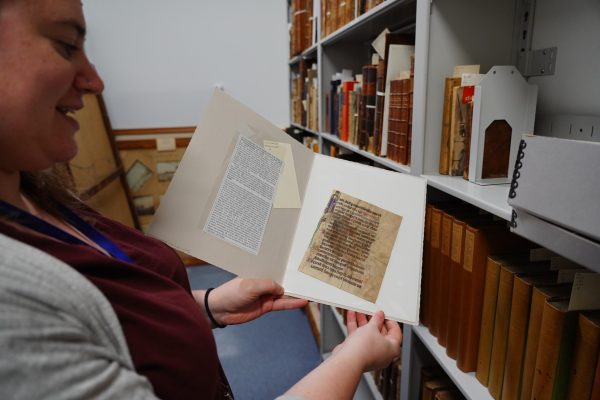
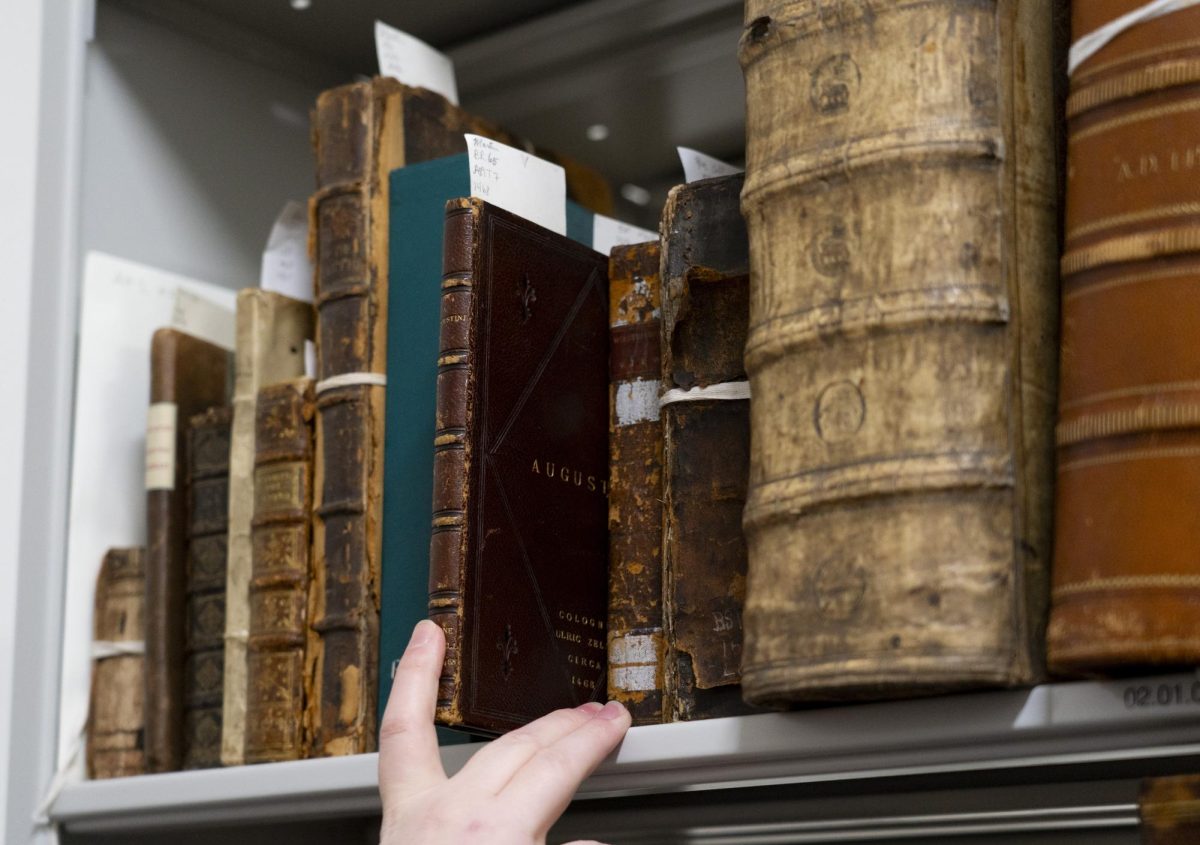
Leslie Nellis walked through the shelves of the vault and reached for a cream-colored folder on a lower shelf. Opening it gently, she revealed an old, stained sheet of parchment with lines of gothic-looking text and colorful swirling letters beginning each paragraph. A boy holding a sword detailed in still-shining gold hovered on the left of the page. A dragon sat in between the paragraphs toward the bottom.
It was an illuminated manuscript, written by monks in 1260. Nellis said it’s the oldest item in the collection.
Nellis has worked in the archives department since 2014 and serves as AU’s head archivist for special collections and digital initiatives. She said she and a few other staff members are responsible for obtaining, organizing, digitizing and safeguarding the archives.
While there isn’t an official number of materials in the archives, Nellis said it adds up to over 7,000 linear feet, a measurement of shelf space archivists use to quantify collection amounts. This trove of material is organized into collections, which generally categorize the records by creator.
For over 60 years, AU’s Archives and Special Collections has been not only preserving a slice of history but educating the community on how to study it. Nellis said the archives are now more visible than ever before. AU archivists and professors said that students use the archives for classes, personal projects and to create exhibits. Professors said they incorporate archival research into classwork. Nellis said researchers from around the world delve into the archives’ primary sources and rare collections.
Beginnings
Adjunct Professor of History and Archivist Helen Chatfield founded the archives in 1958, Nellis said. Before then, Chatfield lectured at AU’s Archival Institute, a summer program that educated students about archival research, according to a June 29, 2015, article on the archives’ website.
The collection began with university documents that Chatfield gathered from offices around the school, Nellis said. It has since expanded to include rare books, manuscripts, journal entries, digital files, posters, photographs, correspondence, blogs and more, according to AU’s web page about the archives.
A key part of Nellis’ role is acquiring new items for the archives, she said. These mostly come through donations. The archives department isn’t looking for just any old papers, though. Acquired items must be useful, in good shape and align with the archives’ specialties, Nellis said.
The archives aren’t just a place to safely seal important documents for future historians, either. Researchers use the department to uncover critical aspects of the past. Nellis said this purpose guides archivists, who collect records that community members will use.
Nellis said the archivists also tend to look for unpublished work, meaning first-hand, unofficial accounts of events and people’s lives.
The department has two divisions: the American University Archives, which includes records that tell the story of AU, and Special Collections, which includes all of the collections that aren’t
directly related to the university’s history.
Special Collections still has a specific set of focus areas, including journalism, photojournalism, international studies, local history, women’s collections and government, Nellis said.
“The strengths of the school reflect the strengths of our collection for the most part,” she said.
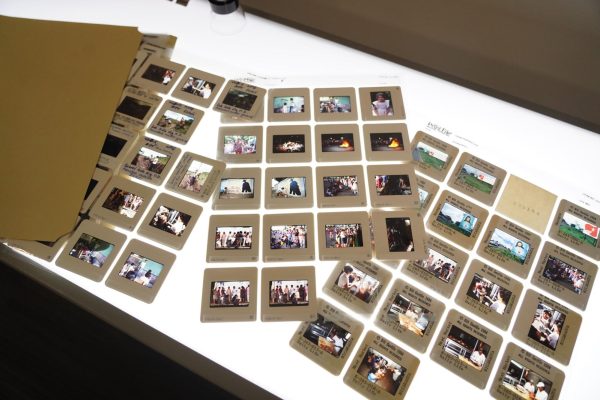
One area of the Special Collections is focused on the Peace Corps. It’s composed of handwritten letters, journals, diaries, photographs and recordings from Peace Corps volunteers donated by the people who created them, Nellis said. Together, they tell the raw, unpublished story of the past 50 years of Peace Corps history.
“Its not something you necessarily see if you go to the National Archives and study the records of the Peace Corps agency,” Nellis said.
The story of AU
The archives preserves AU’s history through copies of student newspapers, yearbooks, court documents, photographs, videos, meeting notes and other records. For any specific event or issue in AU’s history, there might be accounts from three or four different perspectives within the archives’ shelves, Nellis said.
Anna Kaplan, a professorial lecturer of history, said including a multitude of diverse angles is an important aspect of an archivist’s job.
“There might be sort of this, like, dominant narrative that the administration tells about the university,” Kaplan said. “But I think archives give us this opportunity to go in and see what are these different stories that different communities or groups related to the institution tell about that institution.”
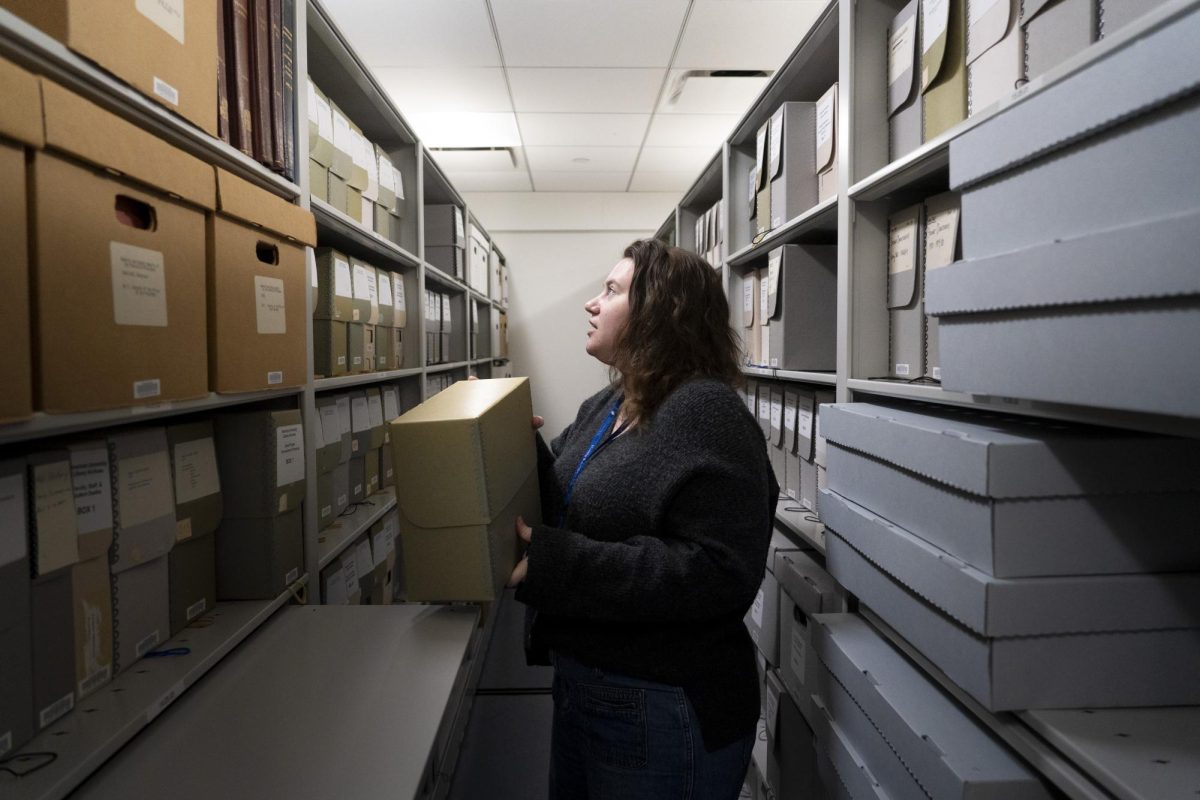
In one section of the archives, AU’s historical records are stored in gray boxes. Walking through an aisle of closely packed, movable shelves, Nellis pulled one down.
“This is a box of correspondence from one of AU’s longest-serving and probably most transformational presidents,” Nellis said.
Nellis gestured at shelves filled with gray boxes.
“All of these boxes through here are all records of student government,” Nellis said. “And the drama in these pages.”
Digital world
Most of AU’s archived materials are not yet digitized, Nellis said. In fact, Nellis estimated that just 5% of the archives are available online. Still, that small slice includes over 60,000 items.
While Nellis generally focuses on obtaining new materials, Laura Bell, the associate archivist for collections management, access and discovery, said she figures out what to do with the materials once they arrive. Bell said all of the archives department’s staff members wear a lot of hats.
Bell said the archivists’ goal isn’t to digitize everything. Instead, the team prioritizes digitizing records that are in bad physical shape or are requested often.
Though digitized versions of most of the materials aren’t available online, the archives department’s website lists the name, contents and origins of most collections in the archives, Bell said. Those names and descriptions, called “finding aids,” allow researchers to use the archives’ website to search for collections before visiting them in-person, Bell said.
Creating these finding aids, organizing collections and digitizing them if necessary and possible takes time, Nellis said.
“You could have the most amazing collections, but if you don’t have the staff to make them shine, there’s a limit to what you can accomplish,” Nellis said.
The archives department could use more staff, Nellis said. The department usually employs around nine students to help out with processing collections, preserving materials and creating library exhibitions.
“Our students do almost all the digitization that comes out of our unit,” Nellis said. “They’re really busy down here.”
Access
The archives are tucked away and locked on the second floor of AU’s Spring Valley Building. The department requires visitors to make an appointment through an online form to access materials, and an archives staff member must stand by while researchers examine records, according to AU’s web page for the archives.
Yet, in some ways, the university’s archived records are more accessible than the campus library.
Jee Davis, who has been AU’s university librarian since 2021 and oversees the library and archives, said the archives’ materials aren’t just for AU students and community members. Access to archival material doesn’t disappear when students graduate like the library’s databases, Davis said, and people with no affiliation to the university are allowed to access them.
“Information is an equity issue in my experience,” Davis said. “And the more we try to work together to make information available to more people, not just one part of the community, but the global community, I believe we can really help advance humanity.”
Access to research databases that the library pays for can cost millions of dollars to purchase from publishers, Davis said.
Meanwhile, the archives contain content that AU owns and can be freely accessed by anyone.
Because of the relatively accessible nature of the archives’ contents, researchers from across the globe have accessed it, Davis said. For instance, Nellis said researchers from Japan have visited the archives to analyze the Japanese wood block collection.
And, of course, AU community members also use the archives. In-the-know students working on films or art history theses, professors looking to teach classes on specific historical topics and student journalists looking to delve into AU’s historical records for a story all use them, Nellis said.
This semester, Kaplan said she is teaching a public history practicum for master’s students. She said groups in the class are working with the archives department to create digital exhibits about the history of archiving.
One group is examining the history of women archivists and their lack of representation within the archives themselves, Kaplan said. Another group is looking at how communities have pushed back at their own erasure in institutional archives — they’re adopting archival techniques for their preservation within the community.
The exhibits will be available online at the end of the semester, Kaplan said.
The ability to search for information using an archive requires some detective work beyond what’s required in a usual internet search. Students often look for archival records by searching the name of exactly what they want to find, but archives lend themselves to more creative research techniques, Kaplan said.
“I would like for students to think about archives and collections as opportunities to discover things about their project that aren’t just handed to them in the title of the collection,” Kaplan said. “But it’s an opportunity to do a little bit of scavenger hunting and thinking creatively.”
Kaplan and the archivists recommend that AU students take a trip to the archives.
“Archivists are always happy to help people see what’s in the archives and help people discover something new,” Kaplan said. “So if you’re just curious, then just go. Just go visit.”
This article was originally published in Issue 38 of AWOL’s magazine on April 15. Read the issue here.
Edited by Kate Kessler, Stevie Rosenfeld, Ava Ramsdale, Will Sytsma and Caleb Ogilvie.