
Skip to Content

What should you do if an active shooter’s on campus? Some professors say AU never taught them.

Faculty said there are weaknesses in emergency trainings and procedures.
Isabella Laverty was in a Kerwin Hall classroom on Oct. 14, 2024, when the phone on the wall rang and her professor chose not to answer it.
Ava Terry

Editor’s note: For the safety of students and professors, AWOL decided to not name the specific classrooms and workspaces that professors raised safety concerns about because people could use the information maliciously. AWOL decided that that information crossed into the threshold of harm.

An American University Police Department classroom telephone rang on Oct. 14, 2024. The professor did not pick up, said Isabella Laverty, then a sophomore in the School of International Service.

AU notified the community that a dangerous subject was in the area through an AU alert and post on X. The university instructed people on campus to lock doors, avoid windows and find a safe place to hide.

Laverty said her professor, whose name she could not recall, did not seem to know how to react. The professor shut the door blinds and continued teaching. Laverty said she was taken aback by her professor’s apparent lack of awareness.

AUPD determined shortly after the incident that there was no threat to people on campus. The suspect was carrying a toy gun, according to a statement issued later that day.

But people have brought real weapons to campus before.

A man brandished a gun at an employee at the Eagle’s Nest convenience store on March 22, 2013, according to an Eagle article published that day and a presentation AU released during its 2024 Security Review Working Group. Someone with a gun was reported walking near campus on July 18, 2018, according to an AUPD post from that day on the platform then-called Twitter. On April 27, 2024, someone on an AU shuttle bus brandished a weapon in someone’s direction before disembarking and walking towards campus, according to a letter Bronté Burleigh-Jones, AU’s chief financial officer, vice president and treasurer, published that day.

Over a year after the most recent incident, students said they question whether faculty members know how to respond to an active shooter. Professors who spoke with AWOL reported differing levels of confidence in how they would protect students. While some said they’ve received emergency response training from AUPD, other professors said they received no training, minimal training or did not make an effort to educate themselves.

Three professors working in buildings across campus said the layouts of their workspaces put students at risk in the event of a shooting. They said they’re uncertain about the protocols for those classrooms and questioned whether they are adequately prepared to respond to the worst case scenario.

Nationally, guns were used on or brought to a college or university campus 96 times in 2025, according to the Gun Violence Archive’s database on school shootings. During the last one, on Dec. 13, 2025, a former Brown University student killed three people with a gun and left eight others injured at his alma mater, according to the Archive’s web page for the shooting.

Will Sytsma

After a shooter killed 32 students and professor at Virginia Tech on April 16, 2007, according to Virginia Tech’s web page about the shooting, then-AU President Neil Kerwin wrote in an April 27, 2007, memorandum that he wanted to spread awareness of AU’s emergency procedures. Staff members should feel prepared, he wrote.

“One reality from Virginia Tech was that a classroom can be a setting for a campus emergency, so it is crucial to better convey our protocols and procedures to our teaching faculty,” Kerwin wrote.

Procedures for responding

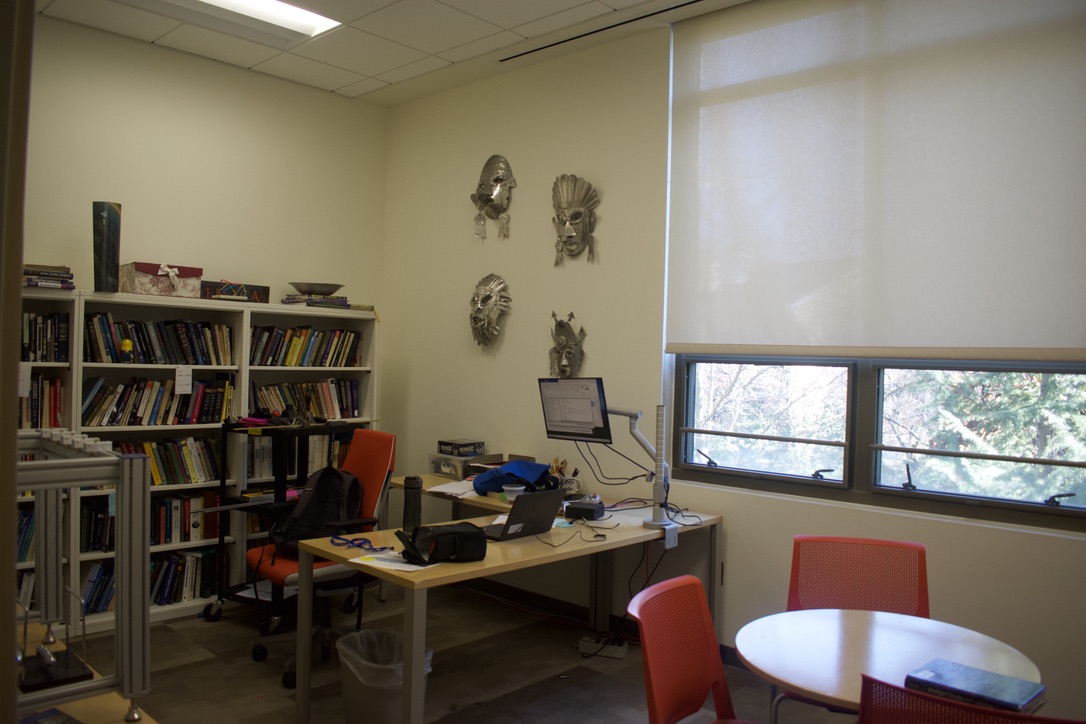
While Laverty’s professor continued teaching during the October 2024 lockdown, Nathan Harshman said he was hiding in his office in the Don Myers Technology and Innovation Building.

When he got the alert, Harshman, a professor of physics, said he vaguely recalled knowing about the “Run, Hide, Fight” method of responding to an active shooter threat.

According to the “Run, Hide, Fight” method, as defined by AU’s “Responding to an Active Threat” web page, those experiencing an active threat should evacuate if possible. If that isn’t feasible, they should conceal themselves in a silent and safe space. And if they cannot evacuate or hide, they should take action to disrupt or incapacitate the aggressor.

Harshman said he decided the best course of action would be to hide and to bring as many students into his office as he could.

“I brought a group of probably about 15 students,” Harshman said. “We were all hunkered down in there.”

  • Nathan Harshman’s office, where he and around 15 students sheltered in place during the Oct. 14, 2024 lockdown.
One of those students was Kurt Hunziker, then a first-year in the College of Arts and Sciences. Hunziker said he was sitting at a picnic table on East Campus when a friend called him about the incident. Not realizing at the time that he should have evacuated the campus, another student let him into the DMTI building and Harshman waved him into his office.

Hunziker said the atmosphere in Harshman’s office was tense.

“People were not talking much, almost holding their breath,” Hunziker said. “People were trying to figure out what was going on, mostly. A lot of people were on their phone, or the professor was checking his computer just trying to find out what was going on. But it was quiet, very quiet.”

In the event of an emergency, AU has a protocol. According to the 2025 Annual Security Report, AU’s president, assistant vice president of university police and emergency management and assistant vice president of risk, safety and transportation services would convene and determine the scope of the emergency. Upon their determination, the AU president would activate the Emergency Management Operations Plan.

The senior director of enterprise risk management, the AUPD chief and, as needed, others would then work alongside the AUPD to issue a campus-wide notification with directions for a lockdown, shelter-in-place, evacuation or other emergency, according to the “Communicating with the Community” section of the Emergency Response Operations Plan. An AUPD staff member at the scene of the emergency may also issue that campus-wide notification.

Administrators activate a shelter-in-place emergency if they want community members to prevent or reduce their exposure to outside risks, according to the “Campus-Wide Shelter-In-Place Procedures” section of the October 2025 Emergency Management Operations Plan. Outside risks could include chemicals, radioactive materials or weather, according to the plan.

During a shelter-in-place, people should stay in the building they’re in or enter the nearest building, according to the Emergency Response Operations Plan.

Administrators activate a lockdown in response to acts or threats of violence toward community members, according to AU’s Emergency Quick Reference Guide.

Instructions for a lockdown appear similar to instructions for sheltering in place. But those outdoors, like Hunziker was, are advised to leave campus, according to AU’s Emergency Procedures Guide web page. The Emergency Operations Plan doesn’t include instructions for lockdowns.

Evacuations involve fires, bomb threats and suspicious packages, according to the Emergency Quick Reference Guide.

During an evacuation, people on campus should go to the Metropolitan Memorial Methodist Church across the street from Roper Hall, the National Presbyterian Church down Nebraska Avenue or St. Ann Church in Tenleytown, according to the Emergency Operations Plan.

It is important to note that these responses are what the university has planned for in writing, but real-time alerts they issue are adjusted to the situation and could thus differ.

The Oct. 14, 2024, alert did not specify whether a shelter-in-place or lockdown was in effect.

Elizabeth Deal, AU’s vice president and deputy chief communications officer, wrote in an email to AWOL that AUPD is committed to ensuring the AU community is informed and prepared. Students and faculty can refer to online resources such as the Annual Security Report and the Emergency Preparedness Guide, she wrote.

David Pike, a professor of literature, said he could not recall those procedures.

“The fact that I don’t know that it exists tells me that there hasn’t been much of an effort to publicize it,” Pike said

Matthew Bennett, AU’s vice president and chief communications officer, wrote in another email to AWOL that AU trains faculty and staff on these protocols and conducts emergency response exercises campus-wide. The university reviews its procedures continuously, he wrote, adding that preparedness is not a static achievement but an ongoing responsibility.

Lisa Mannapova, a junior in the Kogod School of Business, said she doubts that the university alone can keep her safe in a shooting incident on campus. Despite any institution’s best efforts, Mannapova said, mass shootings can never be fully prevented on an open campus.

“I personally don’t have peace of mind knowing that anyone can walk through these doors, and a lockdown isn’t going to help with that if they’re already within the premises,” she said. “Just knowing that makes me feel unsafe.”

How are faculty trained to respond?

Some universities in Washington, like George Washington University and Georgetown University, offer in-person training sessions to faculty and staff members on how to handle a mass shooting within their institution, according to their websites. Some universities beyond Washington have made readiness training mandatory, like Austin Community College in Texas and Jackson State University in Mississippi.

There is no information about faculty training programs on AU’s website.

Harshman said he never attended or heard of a university-sponsored training session. He only remembered receiving an email in 2013 from Dan Nichols, then-executive director of university safety programs.

In it, Nichols wrote that Kerwin and his cabinet advised the community members to view a video about “Run, Hide, Fight” produced by Ready Houston, an emergency preparedness campaign based out of Houston, Texas, according to a copy of the email Nichols provided AWOL.

A Federal Emergency Management Agency video was also offered “for those wishing to have in-depth training.”

Another video, produced by the FBI, is embedded on AU’s current web page for responding to an active threat. It depicts people at a bar utilizing “Run, Hide, Fight” tactics to protect themselves.

But Harshman said videos like the ones included in Nichols’ email are not proper training for faculty members because they’re generic. Harshman said his role as a faculty member is different from those who such videos are typically targeted toward.

“A typical person in the workplace works with a small team of four or five people. They’re pretty stable,” Harshman said. “As a faculty member, I work with maybe 100 students in a semester, and then it changes, and they’re all new.”

Some faculty members said they have received university-sponsored emergency
training, though.

Sung Joo Kim, an assistant professor of information technology and analytics, started his position in August 2025 and said he opted into attending a training for Kogod faculty members hosted by AUPD Officer Rima Sifri. He said the training was highly recommended.

Deal did not make Sifri available for an interview.

Kim said more than 100 faculty members attended the training as part of a larger faculty meeting. He said many in attendance appeared unengaged.

He said Sifri discussed having to decide in the moment whether the October 2024 incident should be treated as a shelter-in-place or a lockdown.

“She basically explained how she was feeling, whether she should shut down all the doors or should let the students go out rather than just stuck in the building,” Kim said.

Kim said Sifri offered to speak to any concerned faculty members’ classes about the university’s emergency preparedness protocols.

Shawn Janzen, a professor of information technology and analytics, said he was required to attend an AUPD training over Zoom as part of his faculty orientation in 2023.

Janzen says he hasn’t heard of any trainings since. Having the ability to attend additional trainings would be helpful, he said.

“It wouldn’t hurt,” Janzen said. “It’s also something that we can use to communicate with others, all faculty and staff, whatever curiosity they want going through this sort of thing.”

AUPD offers self-defense classes and other safety awareness programs to teach community members about their responsibility for both their security and others’, according to the university’s web page for the self-defense classes. Sifri previously offered private classes too, according to a 2018 archived version of the web page, but that page has since been deleted.

Sifri has conducted briefings within individual schools at the university, some faculty members said. She held one on Sept. 17, 2025, at the School of Public Affairs Council Meeting.

Nathan Favero, a provost associate professor of public administration and policy, said he attended a Sept. 17, 2025, briefing. He said Sifri explained the “Run, Hide, Fight” protocols and other resources.

Favero said that while he doesn’t think it’s possible to feel entirely safe during a shooting incident, he believes AUPD has done all they possibly can and should to provide ample preparation.

“It’s hard to feel confident,” Favero said. “I’m scared of guns, but I don’t feel like I’ve been wanting something from public safety that they haven’t provided.”

Kyle Brannon, a Hurst senior professorial lecturer of film and media arts, said Sifri also provided a briefing during a Fall 2025 SOC faculty member meeting. He said Sifri taught faculty members about AU’s procedures to avert shooting incidents and explained how AUPD officers are trained to interact with students.

Brannon said the AU Alerts have always given him ample instruction on how to respond to an incident.

But faculty members like Harshman and Anita Sherman, a professor of literature, said the university has never trained them.

Sherman said she’s never received formal preparedness training from the university, but doubts that it would be effective anyways.

“I don’t know whether it’s a good investment or not,” Sherman said. “I think studies would have to be taken to see whether that’s a good investment or not, but I’m not even sure it’s worth investing money into those. People should read those studies on their own. I’m not sure the university should invest money, given that they have so many budget problems, just to anticipate a possible disaster.”

She said she would only attend a training if it was mandatory.

Kim, who attended the 2025 session, said regular trainings would help faculty members better remember the university’s protocols.

“These protocols, the most important thing is being repeatedly exposed to it so that you don’t forget it, or maybe just hold onto your muscle memory,” Kim said. “So, it’s very effective, at least, having that on an annual basis, or at least periodically.”

While faculty members are occasionally concerned about the university’s approach to emergency preparedness after a mass shooting, it’s not an issue always on most faculty member’s minds, said John Bracht, a professor of biology who is also the president of AU’s chapter of the American Association of University Professors.

Concerns lay not in the university’s procedures but the administration’s ability to make faculty aware of them, Bracht said.

“Gun safety is not our main mission, but shared governances and making sure that faculty have a voice in those decisions is,” Bracht said. “So, it’s more from that angle rather than being concerned about the safety protocols themselves. We’re concerned about the faculty’s awareness.”

“Sitting ducks”

During a lockdown, people should shelter in a room without windows, according to AU’s Emergency Procedures Guide.

If this isn’t possible, they should cover all the windows. But students and faculty members said they’re worried that some buildings’ layouts jeopardize people’s ability to hide in an emergency.

Some classrooms across campus are located in buildings’ lower or terrace levels. Some classroom doors don’t have blinds, making it difficult for individuals to conceal themselves as recommended in the Emergency Procedures Guide.

Mikael Bustamante, a first-year in Kogod, said it would be difficult to evacuate many of AU’s classrooms.

“What I noticed in classes is that there’s mainly one exit, and if someone were to come in, like, there would be no places to go,” Bustamante said.

The doors of some DMTI classrooms are see-through and don’t have curtains. Harshman said a university administrator should come through classrooms in buildings like DMTI and identify potential security weak spots.

Harshman said one particular classroom in DMTI is especially dangerous. He said he’s unsure how students in that classroom, which can hold 60 people and has glass windows facing the hallway, would protect themselves.

“What is the protocol for those 60 people?” Harshman said.

The emergency preparedness protocols state that windows facing the hallway should be blocked during a shelter-in-place or lockdown, but does not specify how. Bennett added that occupants of such classrooms should also secure the classroom door, stay quiet, silence phones and remain
out of sight.

Bennett also explained that in basement-level spaces or any room where standard guidance may need to be adapted, community members should follow real-time instructions issued at AUPD via
AU Alert.

Sherman, the literature professor, said she used to administer exams in a particular space of Anderson Hall.

After the April 16, 2007, Virginia Tech shooting, Sherman said she began to question whether the space put her students at risk.

“I remember thinking, ‘Wow, should I request a change of exam room?’” Sherman said. “‘Should I rethink my exam policy?’ You know, those were the computer labs that we’re in, there was just one door and, as I say, no windows at all. I felt like if somebody comes in, we’re all sitting ducks. It’s a massacre.”

But faculty members don’t always have a choice of location.

Kim currently teaches three sections of Business Analytics in a classroom with no windows on the terrace level of the Kogod building. Its double doors have large panes of glass with no blinds.

Kim said he’s concerned about how his students would be able to safely hide.

“The only thing I can think about is, first of all, let the students hide under the desks, and we can put a bunch of chairs so that there’s at least enough barriers,” Kim said. “And probably turn off the lights.”

In the Emergency Management Operations Plan, the university defines designated evacuation sites for each building. In an emergency, the plan directs community members inside Kogod to evacuate to the quad or the Mary Graydon Student Center.

When Kim realized he was unaware of the university’s evacuation procedures, he said he regretted not being more informed.

“I feel bad for myself because I’m responsible for these kids, so if anything happens, I should be the one who’s being taking care of the situation,” Kim said.

Correction: In a previous version of this article, the caption to the photo of the emergency phone said Isabella Laverty was in a School of International Service class when an emergency phone rang. Laverty, an SIS major, was in a Kerwin Hall classroom, not necessarily an SIS class.

This article was originally published in Issue 38 of AWOL’s magazine as “What happens when you can’t run, hide or fight?” on April 15. Read the issue here.

Edited by Ava Ramsdale, Clair Sapilewski, Ben Austin, Kate Kessler, Will Sytsma and Caleb Ogilvie.

More to Discover
About the Contributors
Yuri Perelman
Yuri Perelman, Staff Writer
Yuri Perelman (he/him) is a second year journalism student at American University. He has been with AWOL since his freshman year. He’s from Randolph, New Jersey and when he isn’t out reporting, he can be found reading, playing with his pug Maybelline or looking for his new favorite restaurant.
Rachel Novick
Rachel Novick, Staff Writer
Ava Terry
Ava Terry, Staff Writer and Multimedia Contributor
Ava Terry (she/her) is a sophomore from Virginia Beach, Virginia. She is majoring in journalism and minoring in studio art, and when she’s not doing homework, she enjoys going to concerts, creating collages and traveling with multiple cameras.