
Washington’s hate crimes law infrequently delivers justice
Content warning: This article discusses hate and bias-motivated violence against members of the LGBTQ+ community.
On Aug. 17, 2024, Christian Dingus and his partner entered the Shake Shack by Dupont Circle alongside a group of friends. But after Dingus and his partner shared a kiss while waiting for their food, a Shake Shack employee asked them to leave. Dingus said his partner argued that they had done nothing wrong, but employees then escorted him outside.
Dingus watched the employees surround his partner outside, so he went outside, too. He told them to leave his partner alone and their focus turned to Dingus.
“Next thing I know, they kind of just all jumped on top of me,” Dingus said.
They punched him until he was on the ground, at which point they began stomping on and kicking him. Metropolitan Police Department officers approached and filed a report for a suspected hate crime.
Shake Shack did not respond to a request for a comment.
Nearly two years after the incident, Dingus said he and his lawyer have reached a settlement with Shake Shack, but he has heard nothing from investigators. It’s one of hundreds of suspected hate crimes reported between 2012 and 2024 that seem to have gone unprosecuted as hate crimes.
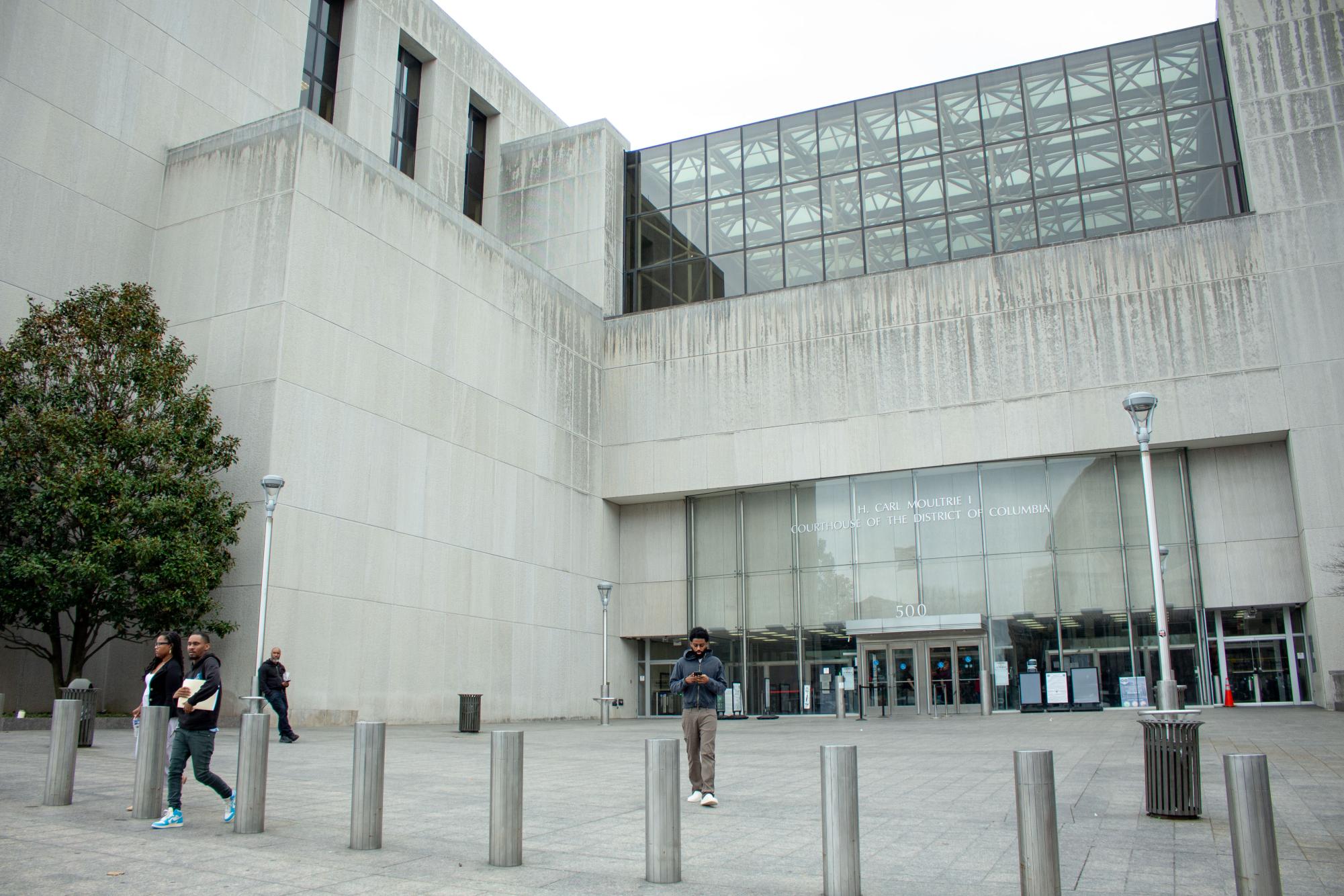
Between 2012 and 2024, people committed 1,681 suspected hate crimes in Washington, according to MPD’s hate crimes data. Washington’s U.S. Attorney’s office charged 92 of those cases with hate-bias sentencing enhancements designed to punish hate crime offenders in D.C. Superior Court, according to data the court provided AWOL.
The hate-bias enhancements expand the fine or prison time of an offender by up to 1.5 times the maximum punishment for the original crime, according to the District of Columbia Code.
Those numbers don’t include cases brought by the Office of the Attorney General for the District of Columbia or cases brought in federal court.
Two experts in hate crime reporting history and LGBTQ+ anti-violence fields said the gap between reported hate crimes and those that end up charged with hate-bias enhancements could have more than one cause. Those experts said limited investigative resources, the difficulty of compiling enough evidence to convince juries that bias was at play and politics’ influence over the appointment of the U.S. attorney for the district are potential factors. Meanwhile, some Washington-based organizations are working to address hate before it turns into physical violence.
When asked for comment, Lee Lepe, an officer in MPD’s Office of Communications, directed AWOL to Washington’s U.S. Attorney’s Office. The Public Affairs office of Washington’s U.S. Attorney’s Office did not respond to requests for comment on the prosecution data.
The process of moving a hate-bias motivated incident from the reporting stage to investigation and prosecution is complex, involving collaboration from Washington’s U.S. Attorney’s Office, the D.C. Superior Court and law enforcement. Experts said complications in that process can make it difficult for prosecutors to charge people with hate-bias enhancements.
Elizabeth Aloi, a former assistant U.S. attorney in Washington who was chief of the Public Corruption and Civil Rights Unit at Washington’s U.S. Attorney’s Office, said it’s important to deter people from committing bias-motivated crimes and to protect the marginalized communities that are victims to them.
At the scene of the crime, the first step of investigating a hate crime is for MPD to issue either an incident report for non-criminal offenses or an offense report for a criminal offense, said Maria Mendoza, an MPD officer and a member of MPD’s Lesbian, Gay, Bisexual and Transgender Liaison Unit.
In order to file offense reports, MPD first investigates if the offense was motivated by bias, a threshold that is typically met if investigators find evidence of any sort of biased statement or slur, Mendoza said.
While MPD typically handles incident reports, the FBI investigates offense reports on a case-by-case basis, Mendoza said, aiding Washington’s U.S. Attorney’s Office and the D.C. Superior Court.
Matthew Gano, a special agent, said the FBI’s role in hate crimes cases includes gathering evidence and determining bias while collaborating with Washington’s U.S. Attorney’s Office and MPD. They look for written statements or vandalism at the scene and go through social media and online statements, Gano said.
Aloi said Washington’s U.S. Attorney’s Office can prosecute hate crimes under two main authorities: a Federal Criminal division of the office that handles federal offenses and the Superior Court division that handles D.C. Code offenses.
Once an investigation is referred to Washington’s U.S. Attorney’s Office, the case moves to prosecutors, who work with the FBI and MPD to consider whether a charge can be brought and to identify the most appropriate charge, according to the office’s Bias-Related Crimes web page.
Complications can arise throughout investigation and prosecution processes, leading to fewer hate crime charges, said Christopher Ewing, an assistant professor in Purdue University’s history department who has published articles on the ineffectiveness of hate crime laws.
Ewing said it can be challenging for prosecutors to gather enough evidence to prove that prejudice was at play in front of a grand jury. It could be clear to a victim that prejudice played a role in the crime, he said, but that’s not enough to secure a conviction.
“But for a prosecutor, what they have to do is they have to compile enough evidence to prove that there was bias-motivation beyond reasonable doubt,” Ewing said.
When determining the charges to pursue, prosecutors might drop the enhancement simply to better the chances of convicting the offender for the underlying crime, Ewing said.
Stephania Mahdi, a volunteer with the D.C. Anti-Violence Project since 2015, has attended meetings and collaborated with a hate and bias task force run by Washington’s U.S. Attorney’s Office. Like Ewing, she said legal strategy is often the reason for low prosecution numbers. Many reported cases do end up prosecuted, she said, just without the hate-bias enhancement in order to better the chance of appealing to the jury.
“We’ve seen this before,” Mahdi said. “Where someone was obviously assaulted, and they added that hate-bias enhancement, and the jury was hung on that enhancement.”
Reworded juror instructions might help increase the likelihood of convincing juries to add enhancements, Mahdi said. Making hate-bias enhancements easier to understand and therefore less challenging to prosecute could, in her opinion, raise prosecution counts.
Ewing said politics could also factor in, as an appointee of Washington’s U.S. Attorney’s Office may carry a political agenda based on the president that they served under.
While at the D.C. Anti-Violence Project, Mahdi volunteered under U.S. attorneys that both President Donald Trump and former President Joe Biden had appointed. Under the current U.S. attorney appointed by Trump, Mahdi said attendees began receiving less information regarding hate crime prosecution with little explanation, leading to the end of her attendance.
Madhi said she believes having Washington’s mayor appoint the district’s U.S. attorney would better serve the interests of the Washington community.
The number of crimes MPD reports as hate crimes may also influence the gap between reported hate crimes and prosecuted hate crimes, Ewing said. MPD officers tend to more frequently report hate crimes compared to other big cities, he said, which may lead to a larger gap between reported crimes and charged cases.
“We do see D.C. police taking this seriously and reporting it and reporting it robustly and having resources to do that,” Ewing said.
Some organizations in Washington are addressing hate crimes at their roots, focusing on that community element rather than the legal side of the issue.
Hala Furst, the organizer of the Polarization and Extremism Research and Innovation Lab at American University, said hate-bias enhancements don’t address the crime that has already happened.
“The person who’s been harmed has already been harmed, or the group of people that’s been harmed has already been harmed,” Furst said. “And violence has already occurred or been attempted.”
PERIL tries to prevent discriminatory or hateful mindsets that inspire acts of hate before they can manifest in an attack, Furst said. Directors and researchers examine ways to strengthen people’s psychological resilience against conspiracy theories, misinformation, disinformation and extremist content, Furst said.
PERIL has launched several programs to put into practice those research-based interventions like Community Advisory, Resource and Education Centers to identify specific community needs when addressing extremist ideologies, according to PERIL’s web page for the program. The centers host workshops for professionals and community leaders and provide resources and advice for people in crisis.
Other programs either under PERIL’s advisory or collaboration include an elementary school curriculum focused on social-emotional learning and training on community dialogue and resisting violence.
There are two common drivers of anti-LGTBQ+ violence: male supremacy and Christian nationalism, said Pete Kurtz-Glovas, who served as PERIL’s deputy director of regional partnerships until June 2025.
Patrick Riccards, executive director at Life After Hate, an organization that aims to teach compassion to extremists, said the online world and social media has broadened the realm of extremism. He said the growth of hyper-conservative social media platforms such as Truth Social, Parler, Telegram and Gab have given extremist ideologies a space to flourish.
Life After Hate works to disengage people from violent behavior when they have already been in hate spaces, according to the organization’s “Our Impact” web page.
Life After Hate case managers, social workers and exit specialists help violent or hate-fueled people, Riccards said. Exit specialists are former extremists that have successfully disengaged from hate groups and want to help others do the same. Throughout programs lasting between 18 and 24 months, the managers, workers and specialists help participants find jobs, places to live and mental health care, Riccards said. They also help people find other services, like tattoo removal for hate symbols like swastikas, Riccards said.
Case managers should recognize that the most people they’re trying to help developed ideologies because of traumatic events in their lives, Riccards sad. They weren’t born into extremist ideology.
“They were triggered, you know,” Riccards said. “Things happened in their lives that led them to seek different environments, that led them to seek individuals who would understand them, and the movement was more than happy to do so.”
Furst said she and others at PERIL emphasize primary care because it’s challenging to rehabilitate someone who is already attracted to violence.
“And we see that, especially when it comes to radicalization to violence, the process of de-radicalizing someone, once they have walked down that pathway, is very difficult,” Furst said. “It requires pretty significant mental and behavioral health support.”
And resilience, to Furst, is built through community awareness and inclusion.
For Dingus, community in the wake of his attack is key. Dingus said that he’s grateful for the support from his friends and family throughout the investigation process.
Furst said organizations like PERIL are still grappling with solutions. She’s said she can’t say whether or not prosecution is effective.
“How do you prove if the punishment someone received will prevent someone else from doing it?” Furst said. “I think that’s a question that the justice system has been wrestling with on a variety of crimes for a number of years, and I don’t know that we’ve come up with a satisfying answer.”
Edited by Will Sytsma, Lucas Powers, Andrew Kummeth and Caleb Ogilvie.