

About 100 minutes into Advisory Neighborhood Commission 3D’s Sept. 3 meeting, commissioners began raising parallels between President Donald Trump and Russian and Nazi dictators.
The commission was on its 10th item of its agenda, a discussion of Washington Mayor Muriel Bowser’s creation of the Safe and Beautiful Emergency Operations Center, which Bowser proposed to manage the district’s response and coordination with the National Guard, according to a release from the Executive Office of the Mayor.
“My sons both worked at the National Holocaust Museum, and I am loath to jump to comparing what’s happening here to things that happened in Germany and in Poland,” said Commissioner Marilyn Nowalk, according to the meeting’s transcript. “But there comes a point when it’s impossible to not draw parallels and to not say, inch by inch, we are losing our freedom. Appeasement didn’t work for Chamberlain. It didn’t work for Poland. And it won’t work for D.C. Home Rule.”
On Aug. 11, Trump issued an executive order deploying the District of Columbia National Guard in Washington. In the order, Trump cited crime as the primary reason he deployed the guard.
The first three weeks of Trump’s deployment saw reported property crime incidents drop by nearly 25% from the previous three-week period, while reported violent crime incidents fell by 19%, according to the Metropolitan Police Department’s crime database. Days after the deployment, an NBC News4 video showed National Guard officers patrolling Metro stations.
Residents in some neighborhoods have seen the guard near their homes, multiple ANC commissioners said. ANCs are governing bodies with the closest ties to the people in Washington’s neighborhoods, according to the D.C. Council’s website.
Amid residents’ concerns of federal overreach, Washington’s ANCs were home to the local debate over Trump’s deployment of the National Guard in the district. Many ANCs passed resolutions advocating for restoration of local funds and to reject an extension of control over MPD, while one partnered with the guard for community cleanup.
Howard Garrett, a commissioner in ANC 2G, said the drop in crime doesn’t justify Trump’s crime rhetoric and the deployment, as crime was already on the decline.
“There’s no emergency that the president is claiming,” he said. “There’s no emergency, that something is going on. So, I think we need to stay away from that type of rhetoric.”
Miguel Trindade Deramo, the ANC 1B chairperson, said he felt the deployment was unnecessary.
“It just had a distinctly un-American feel,” Trindade Deramo said.
“Nobody is happy”
Since Trump deployed the National Guard on Aug. 11, some Washington residents have resisted the guard’s deployment and the mobilization of other federal law enforcement agents across Washington. Local organizations, including advocacy nonprofit and resistance group Free DC, have organized protests and campaigns to push back against law enforcement presence in Washington.
In an Aug. 20 survey from the Washington Post and George Mason University’s Schar School of Policy and Government, 79% of 604 responding residents said they either somewhat or strongly oppose the deployment of the National Guard and the federalization of MPD; 17% backed it.
Trindade Deramo said support for the National Guard is small in many ANCs. He said ANC 1B, his commission, was one of many ANCs to send a resolution regarding federal overreach to Congress.
On Sept. 8, the D.C. Government Operations Director of the D.C. National Guard Marcus Hunt sent a letter to all of the ANCs requesting their help in identifying projects and initiatives on neighborhood beautification efforts, according to the Home Rule Caucus page on ANC 1B’s website.
Ten days later, Trindade Deramo, Garrett and 60 other commissioners sent a letter to Hunt, writing that the guard’s purpose is to prepare for security threats and disasters. They also called for the National Park Service to receive more funding so it can care for greenspaces. The 62 commissioners are part of the Home Rule Caucus, a group that coordinates ANCs’ advocacy regarding the Home Rule Act, according to ANC 1B’s webpage for the caucus.
Garrett, the letter’s author, said he wrote the letter because he felt that the deployment left his community in shambles. He said he thought accepting Hunt’s offer for help would play into Trump’s hand and undermine the National Guard’s stated purpose.
“That’s not what they’re supposed to do, and it was just distasteful, that I felt that we need to get away from this polarization of the military strolling our streets and playing into the president’s rhetoric,” Garrett said.
Though he said the guard hasn’t been in his ANC, Garrett said his constituents have still experienced government overreach.
“ICE has been in my community, you know, terrorizing residents and apartment complexes, staking out outside of apartment communities that are heavily Latino,” Garrett said.
Trinidade Deramo said few Home Rule Caucus members and other commissioners have outwardly supported Trump’s use of the national guard for local law enforcement, though some have.
“Nobody is happy with the way they’re being used,” Trindade Deramo said. “Nobody. I haven’t heard a single voice saying this is a good thing around here.”
“It could happen here”
Commissioners at the Sept. 3 ANC 3D meeting weren’t all opposed to Bowser’s cooperation with Trump’s order. According to the meeting’s transcript, commissioners Chuck Elkins and J.P. Szymkowicz said the mayor’s cooperation with the White House was a smart and pragmatic move.
Commissioners Tricia Duncan, Mark Blumenthal and Nowalk said Bowser’s coordination with federal forces weakened local autonomy and set a precedent for future interventions even if it did contribute to short-term drops in crime. Blumenthal said the deployment compared to the Russian Empire’s forced deportations and political violence in the 1800’s. Blumenthal’s grandparents immigrated from Russia in the 1800’s due to political persecution.
“They said, ‘it could happen here,’” Blumenthal said, referring to others of his grandparents’ generation. “And I thought they were nuts. I thought they were silly. And now what do I see in our city just over the last few weeks?”
In a resolution, the commission requested that district leadership guide these efforts to restore funds and urge congress to reject an extension of the MPD takeover. They also asked them to require federal agents to clearly identify their agencies and bar them from wearing masks when engaging with district residents and visitors.
The ANC 3D debate was part of a larger effort among at least 40 ANCs to address concerns about Trump’s deployment, Garrett said.
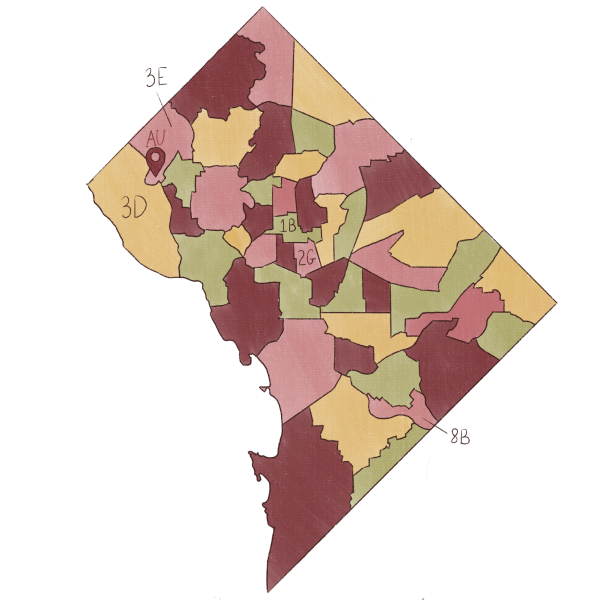
In a meeting the day after, ANC 1B, which represents the area around Columbia Heights and the U Street Corridor in Northwest Washington, adopted two resolutions regarding the National Guard deployment, according to ANC 1B’s website.
The first resolution, named “Condemning Federal Overreach in District of Columbia Policing and Demanding the Immediate Return of Local Funds,” requested that Congress reject any resolution extending the federal intervention beyond 30 days, according to the resolution on ANC 1B official website. The resolution also called on Congress to restore $1 billion of locally-raised funds to the district’s budget for services like healthcare, education and workforce development, according to the resolution on ANC 1B official website.
The second resolution, named “Regarding the Identifiability of Federal Agents and Officers Operating in the District of Columbia,” urged the United States Attorney General to require clearer identification of federal agents across nine agencies, including ICE, the FBI, the Drug Enforcement Agency and the Secret Service.
Trindade Deramo said those resolutions stemmed from concerns from residents over the ambiguous uniforms that some federal agents patrolling Washington have worn. He said their jackets can read something as simple as “police.” He said the federal agents and the masks can mislead citizens and cause distrust in MPD.
“It’s just a terrifying visual for people to not know which agency is conducting an arrest,” Trindade Deramo said.
Trindade Deramo said the deployment is a “shock and awe” patrol model rather than community policing. Despite the federal officers presence, he said there were multiple stabbings in his ANC district between Sept. 9 and 18, the week before he spoke with AWOL. He said he witnessed MPD officers, FBI agents and Secret Service officers arrest an elderly homeless woman with an open container of beer.
“What’s the cost of that size of deployment for one homeless woman who was sitting on a stoop, drinking a beer, not being aggressive, not yelling, not attacking it, just sitting, right?” he said.
Though Trump cited crime as the reason to deploy the guard in the Aug. 11 executive order, Trindade Deramo said the guard is doing menial tasks instead. Before the deployment, he said, the commission contracted these jobs out to companies. He said the guard’s duty isn’t to take on beautification jobs like rehabilitating grass in Meridian Hill Park.
“These guys out here picking up trash and bags, and that’s like the limit of what they can do,” Trindade Deramo. “So, you know, it’s, it’s just offensive to everyone. It’s just a slap in the face.”
“D.C. needed help”
On Sept. 29, ANC 8A Commissioner Tom Donohue sent out a survey asking residents about Hunt’s invitation of D.C. National Guard members, who reside within the district, to participate in targeted community initiatives. Of the respondents, 60% voted in favor of inviting Washington National Guard members who live in the neighborhoods in ANC district 8A — Anacostia and Fairlawn — to join in community-betterment projects, according to a press release.
Donohue wrote in the statement that people who voted against National Guard involvement cited worries about militarization and blurred lines between military and civilian roles, while supporters said they saw opportunity for collaboration and local improvement.
Donohue wrote that the first project National Guard members would participate in a community cleanup day. He wrote that his office encouraged all residents to participate, regardless of their vote.
“My role is to faithfully represent the collective will of our district, and the community has affirmed a path forward that focuses on positive, non-security-related engagement,” Donahue wrote in the statement. “We are moving ahead with the community cleanup plan, which will be a shared effort to better our neighborhood.”
Donohue was not available for an interview with AWOL.
ANC 8B, in an effort spearheaded by commissioner Marcus Hickman in September, invited the National Guard to the commission as a response to Hunt’s offer for aid in city beautification. He said that while there was some disagreement within the ANC about partnering with the National Guard, most commissioners supported the effort once they understood it was for beautification, not policing.
Hickman, who joined the ANC on Jan. 2, said he started a community cleanup initiative in March, before the deployment. He said he saw the Hunt letter as a way to help his previous beautification efforts. Hickman said the government doesn’t often offer aid to Ward 8, so he welcomed the guard’ help.
“In Ward 8, where they always say, ‘Oh, help don’t come over here. Help don’t come over here,’ you know? It was like, ‘OK, let’s see what they gonna do,’” Hickman said.
In a few hours, the residents and guards were able to fill 27 bags of trash, Hickman said. Hickman said other commissioners, like those for 8B02 and 8B05, later partnered with the guard for additional cleanup days. He said they collected 34 more bags of trash.
“It was a movement,” Hickman said.
Hickman said that knowing the National Guard is local to Washington made citizens feel more comfortable because they perceived troops as locals wanting to improve their community. He also said the troops were unarmed.
Hickman said when critics saw the Guard was unarmed and engaged with the community, they largely changed their minds.
On July 4, Hickman said a shooter killed his 17-year-old niece, Zoe Kelley-Hickman. He said her death increased his understanding of how the government can address safety issues in Washington.
“I feel like something needed to be done, and again, this is me before even having knowledge of the beautification,” he said. “I said if the previous administration would have done this, then maybe Zoe would still be here. They had the same access to do it as the current administration has to do it.”
For Hickman, the deployment is no different than armed police walking around. Hickman said on his calls with police, he’s heard crime rates are declining. He said people have a strong reaction to anything the current administration does and that has contributed to the backlash against the National Guard.
“If your house is on fire, do you care who tells you that it’s on fire?” Hickman said. “Your house on fire. D.C. needed help.”
Hickman said Hunt, the government operations director, was personable in his outreach and that the beautification efforts were productive.
When Hickman asked for help with his project, he said the National Guard responded within an hour saying they would be there.
Hunt’s transparency was a big factor for Hickman — he said the guard held a question and answer session and visited in the days after the cleanup to introduce themselves.
“Colonel Hunt explained this in his email: what the D.C. National Guard is and who he is, which is a resident of D.C.a third-generation Washingtonian, he lives over here in Ward 8,” Hickman said. “So it made it very easy to say, you know what, let me give this an opportunity.”
Hickman said he’s excited about the National Guard’s help in the future. But commissioners like Trindade Deramo remain firm in their opposition to Trump’s deployment.
“It’s certainly very un-American to be sitting out at a wine bar, it’s the end of summer, you’re on a streatery on 14th Street and see ten guys walk by with M4s,” he said.
This article was edited by Ava Ramsdale, Kate Kessler, Syd Patak, Will Sytsma, Caleb Ogilvie and Kalie Walker.