


This year, American University reduced its budget for staff and faculty salaries by nearly $28 million, according to budget reports from fiscal years 2024 and 2025.
The cut brought the total amount AU is paying in salaries for all faculty and staff, including those in adjunct and part-time positions, from $314,181,000 in fiscal year 2024 to $286,391,000 in fiscal year 2025. Those changes are part of a broader shift in the university’s spending, as AU has pursued several money-saving initiatives. One was their Voluntary Retirement Incentive
Program.
VRIP, announced last winter, offered long-serving faculty and staff members financial compensation for early retirement.
The program was among measures designed to help meet budgetary requirements and future demands of the university. Other measures included additional revenue generation and strategic organizational and staffing realignments, then-Acting Provost Vicky Wilkins and Chief Financial Officer, Vice President and Treasurer Bronté Burleigh-Jones wrote in a December 2024 announcement.
“These measures — which are detailed below — will help us fulfill current budget requirements and empower us to seize new opportunities,” the administrators wrote in the announcement.
VRIP and the cutbacks in spending on pay have come amid larger budget troubles that have befallen the university. In the Fall 2023 semester, AU announced that its budget had a shortfall of roughly $30.8 million.
In the Fall 2024 semester, AU’s shortfall was $68 million, according to a December 2024 article in The Eagle.
On April 11, 2024, Board of Trustees Vice Chair Gina Adams announced in a memorandum that the university had achieved a balanced budget for fiscal year 2025. But, according to the minutes from a March 5, 2025, Faculty Senate meeting, a Provost’s Report from Wilkins said budget difficulties hadn’t passed.
“There’s no sugar-coating things,” Wilkins’ report read, according to the minutes. “It’s a difficult budget.”
The budget difficulties have largely stemmed from missed enrollment targets over the past several years. Last year, AU projected 386 fewer full-time undergraduates for the incoming class, according to a July 2024 President’s Office announcement. In fiscal year 2025, tuition and student fees made up 78% of AU’s total revenue, according to AU’s fiscal year 2025 Budget Report.
The initiative
The university has implemented various faculty voluntary retirement incentive initiatives across the years, including in 2015, 2019 and 2022, according to annual reports, consolidated notes to financial statements and university policy.
This time, it included both staff and faculty. In a Dec. 4, 2024, announcement, Wilkins and Burleigh-Jones said VRIP allows faculty and staff who are, as of Jan. 6, 2025, at least 55 years old with at least five years of service full-time at AU to receive financial compensation to retire early.
In a May 1 announcement, Burleigh-Jones and Marshall Taylor, AU’s associate vice president and chief human resources officer, said 123 AU employees took advantage of the latest iteration of the program. Thirty-seven were faculty, most of whom retired in May, Wilkins wrote in an email to AWOL. Wilkins said at the March 5 Faculty Senate meeting that employees’ participation in VRIP exceeded what AU’s administration anticipated, according to the minutes.
Literature professor Anita Sherman, who is participating in the program, said VRIP makes financial sense, given AU’s budget.
“It’s to save money,” Sherman said. “They’re having all kinds of budget prob- lems, and the biggest item on their budget is payroll.”
Sherman said she was aware of AU’s decline in enrollment and the university’s need to reduce spending as a result.
“You have to rightsize the faculty in order to reflect the realities of student enrollment,” Sherman said. “And, I mean, to me, that’s sound fiscal management, actually.”
Sherman said VRIP packages vary based on transition period — the time from when staff or faculty accept VRIP to their actual retirement date. AU offered Sherman retirement options over the course of up to three years. She said that if she were to retire immediately, she would have received an additional year’s pay at 125% of her salary. If she were to phase out over the course of three years, she said she would get an extra year’s pay at 80% her salary.
Sherman, a tenured professor, said she chose to continue to teach through the spring because she was excited about the courses she is teaching this year. This means she will retire at the end of the Spring 2026 semester with an extra year’s pay.
Some faculty VRIP participants, like Sherman, were tenured professors. Sherman said she’s working her dream job. She said institutionally-supported research is why most people like her pursue the tenure track.
“Most people who apply for tenure, it’s because they do love doing research,” Sherman said.
Glenn Colby, the senior researcher for the American Association of University Professors, said the program represents another shift toward AU’s reliance on lower-paid contracts as a means of saving money. Colby said the recent shift from tenure-track faculty to non-tenure-track faculty is a disconcerting trend.
AU, by the numbers
Faculty can be hired on a variety of contracts. Professors on the tenure track are hired as assistant professors. Assistant professors can be promoted to associate professors, which generally coincides with earning tenure, said John Bracht, the president of AU’s AAUP chapter.
Tenure provides significant employment protections, preventing the employee from being fired without cause. A university can simply choose not to renew the contracts of non-tenured faculty. After some time, an associate professor may be considered for promotion.
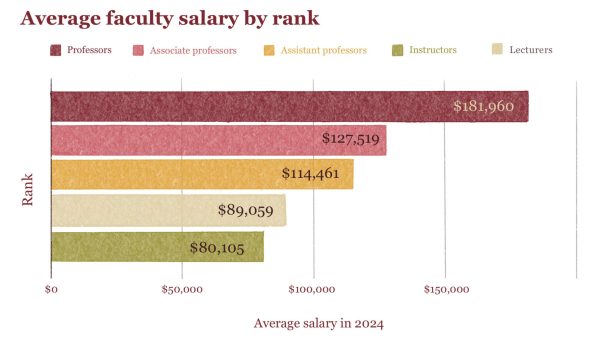
On the other hand, faculty can be hired as instructors and lecturers. These contracts are usually shorter, do not include the possibility for tenure and are paid less on average.
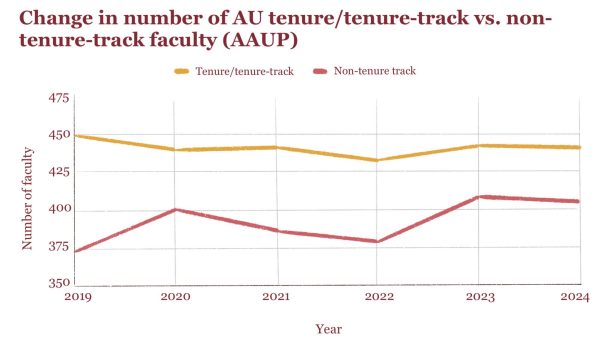
Trends in tenured and non-tenured positions at AU have been shifting. The number of non-tenure faculty grew by nearly 9% from 2019 to 2024, while the number of tenure-track faculty shrunk by 2%, according to an April 7 financial analysis from AU’s AAUP chapter.
Colby, the AAUP senior researcher, said the university’s shift toward part time faculty is stark.
“When I look at AU, it’s pretty shocking to see the trend of the growth in non-tenure track and part-time faculty,” Colby said. “So, AU is relying more and more on non-tenure-track and part-time. Yeah, the percentage of tenured faculty has dropped quite a bit.”
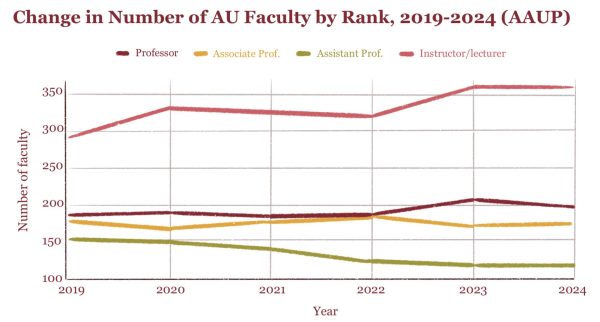
According to the AU AAUP financial analysis, the number of instructors, a non-tenured role, increased by nearly 22% between 2019 and 2024. The number of full professors, part of the tenure-track, rose by nearly 6% during the same period. But the number of assistant professors, those who were hired with the possibility of a promotion to a tenured position, fell by 24%.
The differences between tenure and non-tenure jobs transcend pay. Bracht, the president of AU’s AAUP chapter, said instructors do not have academic freedom protections. Bracht said the university tries to paint continuing appointment, which refers to non-tenured faculty contracts without specific termination dates, as similar to tenure, but that isn’t the case.
“In fact, an instructor or term faculty can be fired at any time, especially if there’s a budgetary issue,” Bracht said. “So, it’s never a stable position. And if you’re not secure, you don’t have freedom.”
Bracht said it looks like AU is de-prioritizing tenure lines because it’s losing assistant professors while expanding the number of instructors.
“There’s this real sense of, like, we’re not investing on the tenure line,” Bracht said. “We’re investing in instructors, and that’s, I would say, a problem.”
How does AU stack up?
When compared to a wider selection of peer institutions, AU has the highest percentage of non-tenure-track faculty, according to the April 7, 2025, AU AAUP report. Its percentage of non-tenure-track faculty is more than double the next peer institution, according to the report. The full financial analysis shows that George Washington University and Howard University were not included in AU AAUP’s comparison.
“If AU is to continue to grow as a major research institution and uphold its newly awarded R1 status, it must make more of a commitment to tenure-track hiring, which has lagged in recent years,” the report read.
AWOL reached out to AU Communi- cations for comment. Assistant Vice President and Deputy Chief Communications Officer Beth Deal said, in part, “Faculty retirements occur regularly even when a VRIP is not offered—and a number of additional 2025–2026 retirees did not participate in the VRIP.”
According to a June 2025 AAUP report, a recent trend has emerged in recent years of universities nationwide shifting from largely full-time, tenure or tenure-track faculty to non-tenure track faculty.
The total number of faculty who took the VRIP offer has not significantly impacted the number of faculty, Bracht said. But he said the broader trend gives him pause.
“So, the overall picture is high number of term faculty, low number of full professors and an under investment on your tenure line over the last five, six years since 2019,” Bracht said.
Ben Austin contributed to this story.
This article was originally published in Issue 37 of AWOL’s magazine on November 17, 2025. You can see the rest of the issue here.
Edited by Ben Austin, Syd Patak, Stevie Rosenfeld, Kyle Galvin, Will Sytsma, Caleb Ogilvie and Kalie Walker.