


When Britten Rollo arrived at American University’s Asbury Building to interview for a position in the Department of Psychology, she found herself lost in the maze of its horseshoe-shaped layout.
“I wasn’t sure if I was in the right place for my interview,” Rollo said.
Rollo not only found her way, but also landed the job. She joined AU in January 2017 as one of two senior administrative assistants in the psychology department. Eight years later, she can no longer work regularly from her office.
“I have multiple health conditions, and they’ve all been kind of aggravated over the years by whatever is in the air in Asbury,” Rollo said.
Asbury is among the oldest academic buildings still in operation on AU’s campus. Its construction was finished in 1960, according to the 1961 edition of the university’s former yearbook “Talon.”
The building was originally named the Francis Asbury Administrative Building after Bishop Francis Asbury, one of the first two American Methodist bishops, according to the university’s website. Today, it hosts student services such as AU Central and the Office of Financial Aid, as well as the psychology department.
Asbury’s primary inhabitants today are psychology department faculty. Several of those faculty members told AWOL they are proud of the purpose the building served for them over the years, but said Asbury is well past its prime.
Developing a new building on the current site of Asbury is one of 10 proposed projects the university said it would complete by 2031 as part of the 2021 Campus Plan. According to the plan, the site the Asbury Building currently occupies could be redeveloped to include a new building with academic and research space. A site plan in the campus plan indicates it would be near the Hall of Science, which was completed in 2020.
Of the 10 projects, only the renovation of the Mary Graydon Student Center and construction of the Meltzer Center for Athletic Performance and the Sports Center Annex have begun, according to the university’s website. Meanwhile, Asbury’s faculty has heard no updates on the redevelopment of their own building. Several cited health concerns, leakage or pests in their workplaces and said the time has come for their department to have a new home.
Reminiscing on the past
David Kearns started at AU as a graduate student in 1997, and went on to work as a professor, researcher and psychology department chair. He said he likes to recall an old joke among psychology faculty on the age of Asbury.
“Many people say when they were hired, they told them that Asbury is on the teardown plan, and it’s going to be replaced,” Kearns said, referring to the university. “One of those faculty members was hired in the ‘70s.”
Kearns is one of two psychology faculty members with offices in the newer Hall of Science. He said the difference between working in a space explicitly designed for research and working in a building that was converted from administrative offices is stark.
“Everything is modern, up-to-date,” Kearns said. “The space is actually designed for a lab, and not just like an administrative office retroactively turned into a lab, and counter space that you can clean easily.”
Kearns said he looked back fondly on the amount of AU psychology students researching in Asbury who went on to teach at Ivy League universities, or to work for important federal agencies like the National Institutes of Health. He said his connection to Asbury is also more romantic.
Maria Gomez, now a professor in the psychology department, started at AU as a Ph.D. student in the late 1990s, fresh off the heels from a position at the NIH. At about the same time, Kearns entered Asbury for the first time as a graduate student and went to work in its animal research lab, a former office space in the basement. Kearns and Gomez worked under different mentors and in different spaces, but often found themselves gravitating toward each other.
“We worked in different labs, but we were here all the time because we were grad students,” Gomez said. “So we were graduate students in the basement.”
The two would go on to marry each other, Kearns said.
“That’s a personally special reason why I like Asbury,” Kearns said.
Asbury wasn’t as new and shiny as Gomez’s previous work environment, though, she said.
“However, I always thought that the courtyard was fabulous,” Gomez said. “You know, the building may not be shiny, but that courtyard is fantastic.”
Observing the present
Kearns and Gomez took different paths in their careers, they each said. Kearns dabbled in administrative work in becoming department chair, while Gomez continued teaching. They both said they appreciate the quirks of Asbury.
Gomez, for one, said she appreciates how easy it is for her to collaborate with the colleagues in her wing.
She also said she considers the size and views of the offices to be a definite strength.
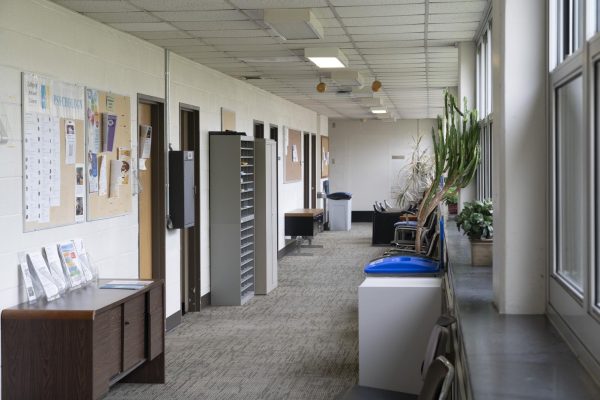
“The offices are actually large,” Gomez said. “You see the Hall of Science? These offices are pretty large compared to them.”
Some newer AU employees who work in Asbury said they see the building not for its storied past, but for its current condition. Maya Davis, a financial aid counselor, said her workplace has experienced an infestation of pests.
“The roaches are just out of control,” Davis said. “I’ve seen a few just in my couple months of being here. I almost stepped on a rat the other day. I just think that the building gives off that it’s not well-kept. Even if they tell us that the pests are being managed, it doesn’t seem like it.”
Eleanor Sciannella, a financial aid counselor, said she is familiar with the pest problem and believes it grew when AU began construction on the Meltzer Center. She said pests also tend to appear when the university switches between heating and air conditioning twice a year.
“They get spooked out of there when it’s particularly hot or particularly cold,” Sciannella said, referring to rodents seeking new nests when the weather changes.
Rollo, the psychology department administrative assistant, and Sciannella both said there’s also been a recurring flooding and water leakage problem in Asbury. Water makes its way in because the windows were faultily installed when replaced 15 years ago and don’t open properly.
“Most of them recur pretty regularly, so I’m fairly certain that there’s still mold and water damage in many places,” Rollo said.
The situation is further aggravated by the lack of ventilation in some offices, like Rollo’s. She said the employees only get airflow when they open the doors to the office, which Rollo said doesn’t do much.
She said the conditions have caused her to work at home. Rollo said she is now seeking updated health accommodations to provide for safer working conditions.
“For me, because I’m very sensitive to respiratory things, I basically just can’t work in the building anymore, unfortunately,” Rollo said.
Seeking the future
Kearns and Gomez both said they would move to a new space for the psychology department if given one. Kearns said he is confident that a project similar to the Hall of Science could be done on the Asbury site.
“If they could turn a small parking lot into what the Hall of Science is, then, yeah, I think they could do something special with Asbury,” Kearns said.
Asbury’s faculty has not heard any updates since the District of Columbia Zoning Commission approved the campus renovation plan in 2021.
“I was in the [AU Faculty Senate meeting] when this proposal was presented,” Gomez said. “So though I imagine one day they will take it down, but probably will be retired at that point.”
Laura Marks, assistant vice president of community and government relations, said in a statement to AWOL that the campus plan was merely a proposal. Whether or not it will come to fruition depends on the needs of the university, Marks said.
“Decisions about individual projects are made based on numerous factors, including budget, timing and operational needs and requirements,” Marks said. “The university is currently focused on the completion of the Meltzer Center and will determine future projects as appropriate.”
Asbury continues to stand without changes.
Sciannella, who serves as the AU Staff Union’s co-chair of organizing, said union members recently negotiated on safe working conditions for faculty members.
The union came to a tentative agreement for a new contract with the university in October, Sciannella said. Asbury wasn’t specifically mentioned in the negotiations, but the resolution between the university and the union will allow faculty members like Rollo to request alternate working environments without repercussions.
“If someone’s doctor says that the working conditions that they’re in are negatively impacting their health, it’s stronger protection for their right to refuse to work in that environment,” Sciannella said.
As for Asbury itself, Sciannella said she would prefer to see a new building that has working windows and is free from pests. If one can’t be provided, she believes the university should, at minimum, address Asbury’s structural issues and do a better job at maintaining the building.
“Whatever the long term solution is, I’d like to see a plan and real investment in making that happen so that we don’t have to keep dealing with these issues,” Sciannella said.
This article was originally published in Issue 37 of AWOL’s magazine on November 17, 2025. You can see the rest of the issue here.
Edited by Kyle Galvin, Kate Kessler, Ben Austin, Will Sytsma, Caleb Ogilvie and Kalie Walker.